Let's Talk with Otso Lauerma ft. Joonatan Laato
21 min read · English / Suomi
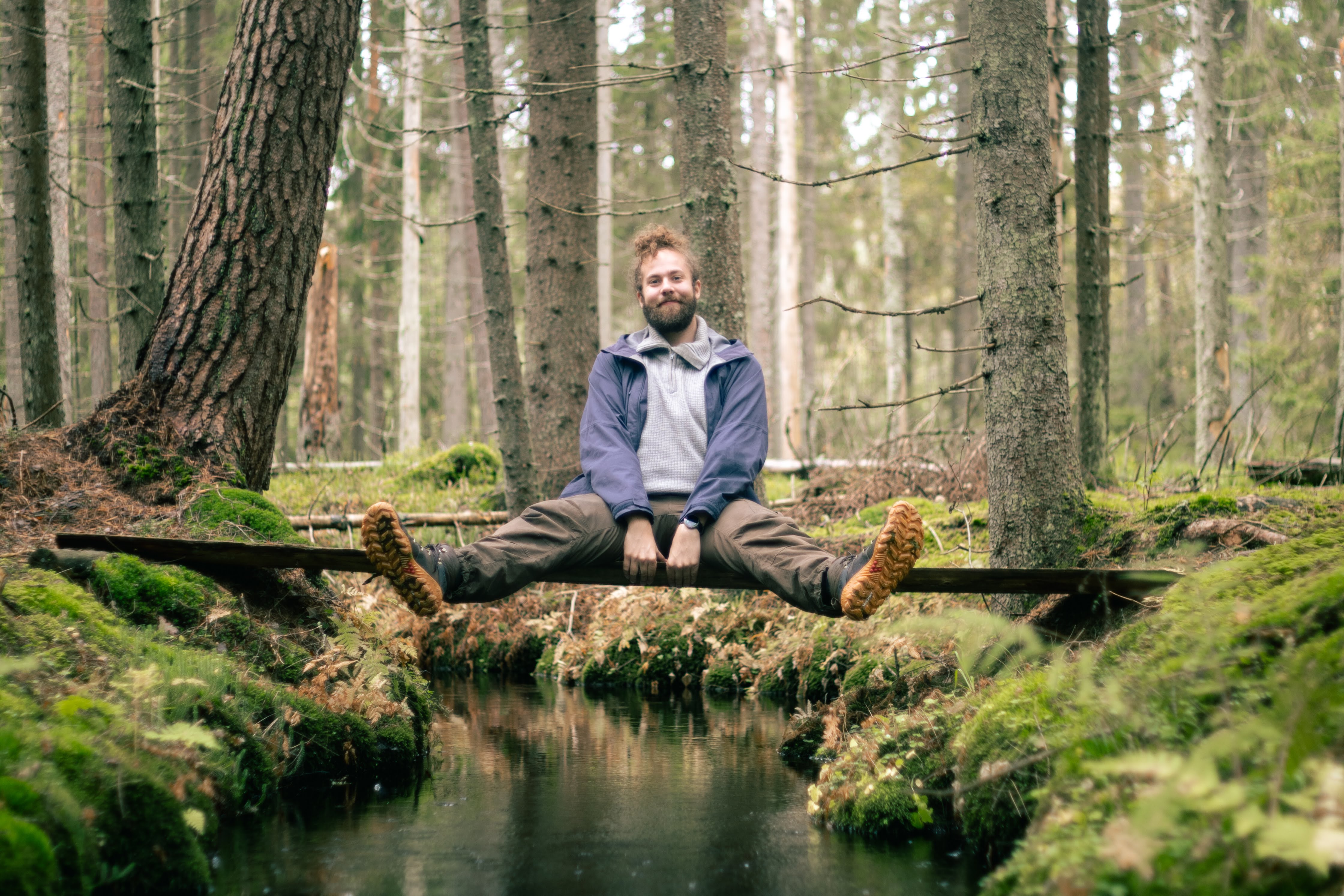 Otso Lauerma.
Otso Lauerma is our friend. Joonatan and I interviewed him twice: first right before he left for a ten-day silent vipassana meditation retreat, and again right after he got back. Both conversations were filmed at the gym, among the machines and weights. The questions below are Ville’s and Joonatan’s, and the rest is Otso.
“It’s like the babbling of a brook, or a well where water flows up from deep below. A little burble that lives there all the time.”
Ville: What do you expect if nothing happens at the retreat?
Otso: If nothing really happened at the retreat, I’d be a little disappointed. I don’t think I should come away with any big insights about how the world works or how I work.
I wouldn’t be disappointed about not getting a grip on the method itself. I don’t think I’d be sad, angry or disappointed about that at all.
I assume I’d end up just examining my own thoughts. I think ten days of just sitting with yourself is bound to be fruitful in some way, whether or not you get a grip on that kind of method. It’s hard for me to believe that nothing would happen.
Joonatan: Especially in an overstimulated world like this one, where silence is a pretty rare luxury.
Ville: What would you do if you came back from the retreat exactly the same as you are now?
Otso: That depends a bit on how you define what doesn’t change. I don’t think the retreat would necessarily open any new doors to inner questions for me. Nor do I expect it to become the kind of thing where I’d even want to meditate by myself afterwards. I don’t think it would bother me much if vipassana turned out not to be my thing.
Joonatan: This would be a much more interesting question if you had some big preconceptions that could crumble. But you’re somehow too grounded. You’re somehow already too ready and open to yourself, to your experiences and to your own thoughts.
Ville: Have you meditated before?
Otso: Not methodically, but I’ve done some mindful breathing exercises. Never for long, just moments here and there. For example, I’ve done Wim Hof exercises following some guide. My old smartwatch had a breathing exercise feature that I used. Then the watch gave out and its battery died, and it couldn’t be replaced.
Joonatan: Does being quiet bother you? When a quiet moment comes, does it start to wear on you? Do you crave some stimulus, a compulsion to put music on, open a YouTube video or scroll Instagram Reels?
Otso: That hits home completely. It’s something I scold myself for quite often: I listen to music the whole time while doing something, or there’s some YouTube video running in the background while I try to concentrate on something else. It’s a kind of bad habit that I still enjoy. Even so, I think I do really well in silence. Even when I’m in someone’s company, I don’t find quiet moments nearly as awkward as many other people seem to. I might even lie in bed, stare at the ceiling and think that I have great thoughts. It’s exciting to just focus on what’s happening in my head.
Joonatan: What do you mean by exciting thoughts? Do some trains of thought start rolling?
Otso: Yes. Usually a thought gets going and then might branch off in different directions. Sometimes it circles back. I really like it when it’s quiet and there are no stimuli around: then I get to follow the flow of thoughts, alternately analyzing and reasoning things out, and alternately just wondering. As far as I understand, though, this is a completely different thing from what vipassana practice aims at. If the goal there is a truly empty mind, that must be a very new experience, if you manage to reach it.
Ville: Is there something you’d miss during the ten days? What will you miss?
Otso: People, probably. People. I like being alone at times, and sometimes even becoming a hermit, but I always come back to needing people in my life. That’s probably the first thing I’d miss. I’ll probably also miss just writing down my thoughts. At first I thought that of course I’d take some notebook along, but the instructions said everything like that has to be left behind. At first that was disappointing, but I think it’s for the best.
Ville: You’ll remember everything you go through there anyway.
Otso: I won’t!
Ville: You will, you will.
Joonatan: Yes, I can tell you that you do remember it. But there can be a danger in that kind of writing, at least when you write down your own experiences: you take too much of a stance on what you experience. You decide too consciously that this experience was like this or that experience was like that, even though things can be happening and changing inside, and you can’t necessarily be sure what it’s about. Another tip to keep in mind is that when you come back from the retreat, you shouldn’t be sure right away about what you experienced. There’s no need to immediately conclude that I experienced this and this and this, that I had this kind of experience and that kind of experience, because the mind hasn’t had time to understand everything yet.
Ville: I can confirm this. I’ve been there four times, and every time it’s the same thing: three months after getting back, I catch myself thinking that maybe I should have thought about it once more.
Joonatan: The mind is so sensitive, so malleable, so susceptible and ready to grab hold of new thoughts.
Otso: Good point about the writing. I really enjoy writing. I feel that through it I find sense in my thoughts and get a better grip on things. I write, I look at it, and I shape it into something real. I think that’s how I eventually get my thoughts neatly bundled. After that I feel like I get hold of some kind of reality in itself through it.
Joonatan: One question that came to mind: if you had to describe the background sound of your mind, no trains of thought, no words, no images, just the background noise, what would it be?
Otso: I can only say it metaphorically. It’s like the babbling of a brook, or a well where water flows up from deep below. Not literally, though: I don’t hear anything other than a slight tinnitus, but a little burble lives there all the time. To some extent, quite a lively background sound.
Ville: Are you the kind of person who thinks more about the future or the past?
Otso: These days more about the future than the past. In my youth I pondered the past, sometimes even to the point of wallowing. But these days I’m maybe more caught up in the future or in the present moment. I’d like to think I’m very present in the moment, but honestly I’m not always.
But it’s exactly that writing and flow of thought: that way I can freeze the burble for a moment. Then I feel like I can really understand my thoughts, that they become somehow more real instead of constantly jumping to different places. Partly it’s also that I rationalize my own thinking by nature: I take some thoughts on the grounds that this is because of this and this, or that this is valid because of this and this, and I discard others. This was now this kind of thought that I have, and it does come from some real place, but it shouldn’t be taken too seriously.
Joonatan: It sounds like you take quite a stand on your own thoughts, though. You weigh them: this is this and that is that, this has a certain weight and that has another. This is a sensible thought, and that’s a useless thought, or a good thought, or a bad thought.
Ville: Is that so? Do you weigh thoughts?
Otso: Yes. I think that’s how it is. It leans toward the virtues I’d like to see in myself: what kind of person I’d like to be. I take the trains of thought and feelings that support that as much more valid than those that don’t. So I rationalize thoughts a lot and weigh them. Writing in particular is the way I experience my thoughts, analyses and values becoming much more concrete. When I get it onto paper, I look at it, and there it is, and I can say that this sentence is true.
Ville: Do you keep a journal?
Otso: Yes, regularly irregularly. Alternately either 45 minutes of morning pages, or I have something on my mind and write about that topic, or just short bits in the middle of the day. It varies a bit. Writing is really meaningful in the sense that I write things down and can look at them and tell myself that this sentence is correct. This reflects something I believe in.
In my head I shape thoughts the same way, because I often think very verbally. I like words, I like turning things into sentences, for example statements. Which sentence is true and which isn’t is part of the same weighing process. The greatest honor you can give to something is to say that this holds true.
Joonatan: I don’t want to assume anything, but it sounds like you look for a lot of reference points for your mind outside yourself. You mirror yourself through text, thoughts, circles of thought, values or events. Are you trying to put your mind into some particular perspective?
Otso: I feel like any kind of abstraction in itself often frustrates me somehow. It feels like I’d like to get clarity and something concrete.
Joonatan: That this is because of this, and that this feeling is because of that.
Otso: That’s exactly how I think. If I feel anxious or have some other feeling, I often handle it by trying to find different causes for it.
Joonatan: If the feeling has some meaning, it’s easier to bear. Then it’s easier to sit with the feeling.
Otso: If I end up, for example, concluding that my anxiety is because I felt someone looked at me strangely earlier today, I note that this may be true, and it’s probably true that someone looked at me strangely. But then I also note that it shouldn’t be given very much weight: this is really quite a trivial thing. It’s a process through which I sort of talk to my own feeling and tell it that this isn’t as big a deal as it feels. After that, the feeling is easier to take off.
Joonatan: Then the feeling is easier to deal with when you put it into words.
Otso: If the feelings are really strong and it’s somehow nice to wallow in them, I might let them stay more abstract. But usually, when I process feelings, I make them concrete and draw these kinds of connections between things.
Ville: I notice you have a really good grip on what happens in your mind. You have a clear mind: you see and recognize what moves through it. They’re not just fleeting things that vanish and pass by. You have a strong inner world.
Otso: That’s really nice to hear. It’s something I’ve developed quite consciously, and I’m kind of proud of it in my own way. But now, as I’m explaining all this to you and you’re more or less just blank slates listening…
(laughter)
Otso: I notice I’m starting to wonder myself: what if this isn’t the only right way to deal with my own feelings? What if I let them be more abstract? What would happen then? I don’t know. Would it lead in that direction? My instinct says vipassana isn’t about looking for inner causes and effects or making things concrete, but rather about sitting inside your own head and body, and letting things wash away and settle on some level.
Joonatan: I feel like emotional processing is often something like this: we’ve made it through life up to a certain point with the tools and chips we have, and that’s what our emotional processing is now or will be ten years from now. It’s just one way of doing it, though. It maybe takes on slightly different shades and perspectives over time, but quite often we do it with exactly the chips we’ve learned by then, the ones through which we know how to identify with feelings or understand ourselves.
Otso: It may well be that I experience this as my own good way precisely because it works for me. I’ve worked with it, and it’s what I return to by default. It’s not necessarily any better or worse than any other way, but it’s characteristic of me on some level. That’s one positive expectation I have. I liked what you said about colors: that something can color how I relate to myself, to my own emotional world or to my body. I’m kind of looking forward to that. When we talk about expectations, what I expect isn’t so much what color it takes on or whether it changes a lot, but that I’d find something different from what I’ve found in my everyday life. That’s the kind of expectation it is.
Joonatan: Well, if you’ve never been on a ten-day retreat, you’ll soon know what it’s like. This already turned into twenty minutes.
Ville: Wow.
“Meditation certainly has a place in my life.”
Joonatan: All right, hey Otso!
Otso: Hey Jonttu and Ville. Hey hey!
Joonatan: You get that performing vibe right away when you step in front of the camera.
Joonatan: So you’ve now tried meditating. Has it been fun?
Otso: Yes. It’s been fun, but I have to say that within a week the enthusiasm has faded a bit. Largely because we came home with huge excitement: “now to bed at ten, wake up at six, meditate, then the gym and so on”. I live with my partner… For now.
(laughter)
Otso: There was strong pressure, in that my partner wants to spend evenings together with me, which is lovely. I’ve been sleeping later and haven’t had time to meditate in the morning. Meditation is much more irregular now, but it has still stuck around.
Joonatan: Is it that you’ve practically done it less, that the sessions have gotten shorter, or that concentrating on the practice itself has been harder?
Otso: Probably a bit of all of those. During the first week I meditated for an hour every morning, now a bit less. I’ve found small gaps where I can meditate for 20-30 minutes at a time.
Joonatan: Yeah, and it’s good to approach it without judgment. Sitting and being patient with yourself help a lot, of course, but I think what’s more important in the end is learning to be present in everyday life. Even if sitting for an hour could support that, the most important thing is to find those moments of presence from time to time.
Ville: You said before the retreat that “if nothing really happened there, you’d be a little disappointed”. Did anything happen there? Are you disappointed?
Otso: No. I don’t really know what happened, but nothing super radical. At least not in the sense I was thinking of back then. The most radical observation was mainly that the posture of my upper back improved, plus a few other physiological changes. It was more about a curious exploration of my own being and focusing on the doing than about any big insights into why everything is the way it is. I still wasn’t disappointed, even though no big click or moment of realization came.
Ville: You said that “you do well in silence and might lie in bed thinking great thoughts”. How did the silence feel for ten days without external stimuli?
Otso: Surprisingly pleasant. At times it could be frustrating, for example during meals, when we were in a small space with the other participants: then I felt like chatting, commenting on something or asking how people were doing, but I couldn’t. I noticed that those moments set my thoughts galloping pretty hard. I let go of the idea when I noticed it was taking my concentration away from the hall. Toward the end, the moments when I wasn’t consciously meditating even got a little boring. All in all, I did really well with the silence.
The hardest part was actually not being allowed to look toward others, and that all speech and nonverbal communication were forbidden. It sometimes made me feel a bit antisocial, for example when someone held a door open for me and then turned their gaze away. But the silence itself was quite pleasant.
Joonatan: Did it take a while to get used to the social dynamic where nobody gives you any social response?
Otso: It took two or three days, but when everyone else was doing the same, it helped considerably.
Joonatan: How did you experience that otherwise? Did it still feel social, being surrounded by people, even though the strongest elements of communication were missing?
Otso: It was different from being truly alone, anyway. You feel like you carry yourself more consciously when there are other people around. You also feel safer: if some emergency came up, you wouldn’t be completely alone.
Joonatan: That’s a really good point. So the mere presence of people increases personal awareness of yourself, in a way. Quite remarkably, even…
Ville: You said that “you listen to music and watch videos in the background all the time, even though you do well in silence too”. Do you want to bring those habits back into everyday life, or has something changed?
Otso: If I’m in a very stimulus-rich environment, for example people yammering around me or something like that, I still like to put something on in the background through headphones.
But I don’t feel any pressing need to go back to the kind of everyday life where a second and third monitor are open and a video is running all the time.
Joonatan: Subway Surfers on.
Otso: I may not have been the world’s worst example of this, but enough that it has annoyed even me. I don’t see a need to push myself consciously in that direction.
Joonatan: Well, how do you feel? Has Otso given the right answers?
Ville: Right ones?! Just his own answers.
(laughter)
Joonatan: How many points does the teacher give?
Ville: Well, let’s see once the points have been counted!
Joonatan: Well, so far so good!
Ville: Did you miss people?
Otso: Yes, I did. But not so that I missed them badly. I missed people mostly through joy: I thought I couldn’t wait to get back to everyday life and see these people again. Not so much with the thought that something is broken because someone isn’t present. I missed different people more through positive anticipation.
“Body awareness has certainly been heightened.”
Ville: You said that the background sound of your mind is like a little burble, the babbling of a brook, which you can follow when lying quietly. How did it show up there?
(laughter)
Otso: Oh no… The burble was definitely my arch-enemy. Burbling all the time, in every direction. I heard it constantly in the silence, and you tried either to calm it or to grow it, but it stayed there all the time. Sometimes it’s like the roar of rapids, sometimes quieter.
On the sixth day I tried to swim against its current, but nothing came of it: it was much stronger than yours truly. In my head I had somehow connected, for example, the constant stream of media to exactly this burbling, but there the understanding rather strengthened that this is more a feature of me than a feature of my environment: it’s just my brain that burbles.
Especially since the environment was so completely free of external stimuli. So it couldn’t be explained by anything external. Maybe it’s just me?
Joonatan: What has that constant stream of media usually meant to you? Has it changed somehow?
Otso: I don’t mean it so much as listening to music or watching videos, but rather a constant flood of stimuli more generally. For example, a situation where I’m sitting with my university friends listening to a really interesting conversation from the sidelines, but I can’t concentrate on it properly. Or someone tugging at my sleeve, or a message coming to my phone, or anything like that: everything external that can turn attention in some direction.
Joonatan: Does the stream of media feel any different now?
Otso: I haven’t approached this very consciously, but I notice that since coming back I’ve started doing something I didn’t do before: I close the laptop in my mind and turn to, say, the person who comes over to talk. I’m cutting down these stimuli quite ruthlessly now. I no longer try so hard to do many things at the same time.
Ville: Joonatan said back then that “you’re too grounded, too ready for your own thoughts”. Did it still feel like you were grounded from the start? Could you open up on how?
Otso: I feel like that hasn’t changed. Many of the things I associate with my own mental stability also showed up in these techniques: they felt really easy and natural. For example, never fully clinging to any feeling as permanent, but observing it as a phase that passes. All of this felt really natural and easy to me.
Mainly, though, it’s that body awareness has been heightened, which I hadn’t really practiced before: being aware of everything that happens in the body. For example, last weekend I was at an improv theater festival in Oulu, and I found it really useful that I meditated before the show. I’m somehow more aware that I live more here, which is something I’ve thought about a lot more in recent years.
In improv, a lot of it is that your head comes up with some relationship or story before you have time to react to what your body is really giving you. These days I think of it more like this: the answer comes from here, from the body, not from the head.
Ville: You said you didn’t expect vipassana to open any new doors to inner questions. Did any such doors open?
Otso: I haven’t found a handle on any door yet, at least. Maybe there’s an entrance somewhere, but I haven’t found a key to it yet. Still, I see vipassana meditation as a whole as a quite clear and possibly very fruitful path.
Ville: Next question… You said that honestly you’re not always present in the moment, even though you’d like to be. Did you stay in the moment better at the retreat, and were your thoughts more in the future or the past?
Otso: I stayed present several moments better (laughter), but not overall: it was really hard. My thoughts went much more to the past, to different phases of my own life. For some reason my thoughts spent a lot of time in my young adulthood. I also pondered the future now and then, but comparatively less.
Ville: Were there any distressing moments?
Otso: Apart from a couple of nightmares, I don’t think so. During the first evenings I might half-awake hallucinate, for example while sitting in the meditation hall: the fatigue from a long week and the intense concentration made me see something that wasn’t really there, and hear something that wasn’t coming from anywhere. Nothing that would have caused severe anxiety, but something that could scare me really strongly. Otherwise I wasn’t distressed there, apart from some small everyday stress that my thoughts returned to every now and then.
Ville: Before the retreat we talked about how we have certain chips that we’ve learned to use for processing emotions. Did you find new chips there? Has emotional processing changed since?
Otso: Maybe a better attitude toward these kinds of situations, through calmness and gentleness. I’d give the credit half to the technique itself and half to the fact that a certain kind of relaxedness, wisdom and gentleness rubbed off from Goenka [a vipassana meditation teacher]. It doesn’t change everything entirely, but it brings a certain kind of peace.
Ville: Would you go again?
Otso: I could see myself going there again. I’m not convinced that, say, in a year, or really at any particular time… But I could see myself going there again! I need to think about it a bit over time. I think I’d primarily go to sit, but why not also to serve as a volunteer.
Ville: When you said you weren’t sure whether vipassana is your thing. Have your thoughts about the method changed in any way? You’ve still meditated since, so maybe you’ve already started to like it?
Otso: Yeah, it has become important to me. Already during the course you could tell I took it seriously: when I went home, my little brother commented, “you’ve actually been studying there!” I have sat there for about a hundred hours now. You learn even by accident. On the other hand, I wanted to spend those ten days focusing on the work better rather than wandering off in my thoughts. It was a good and motivating environment for learning in that way.
Joonatan: Any last worms?
Otso: Last worms, brainworms…
It was pretty nice to get to take part in this trip. I think that almost anything like this, if it’s completely new to you, is already quite an enrichment in itself. I like very much that it broadens my own horizons and worldview: that much at least is true. On top of that, the whole experience is just quite wonderful. Meditation certainly has a place in my life. So far I’ve found it good, and no doubt it will be the same going forward.